Wednesday, March 8, 2017

The Walking Dead Season 7, Episode 12 Review: ‘Say Yes’


(Photo Credit: AMC)
The Walking Dead
Season 7, Episode 12
By Garrett Yoshitomi

We’re into the meaty middle of season 7B, which unfortunately (although somewhat predictably) means we’re due for a filler episode or two. As far as Walking Dead filler goes, “Say Yes” isn’t terrible. It tells a compelling enough standalone story, and utilizes a fun, unique setting for the majority of its action sequences. It’s not as satisfying as last week’s Eugene-centric episode, “Hostiles and Calamities,” but it gets the job done, and even manages to connect back with the main storyline towards the end. Ultimately, there isn’t anything incredibly special about this episode- how you feel about it will largely depend on how much you like the Rick-Michonne pairing. But, being that they are two of the show’s most popular characters, I imagine most fans are fine with the additional screen time getting tossed their way.
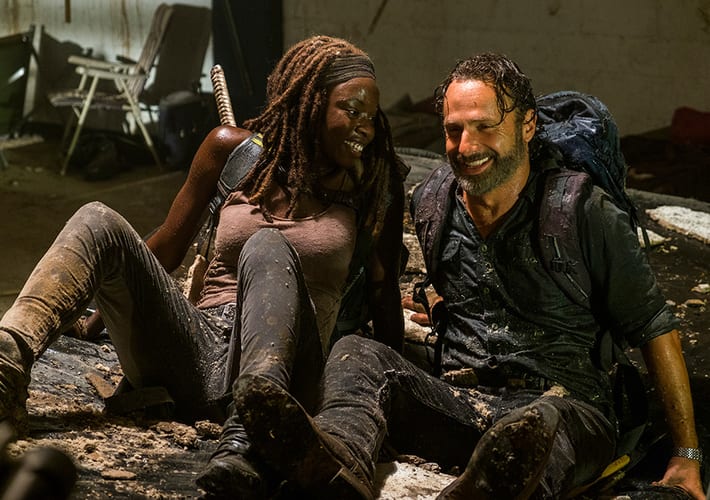
(Photo Credit: AMC)
In a show that can be as bleak and depressing as The Walking Dead, a nice, safe romantic subplot, like Richonne, is a welcome commodity. With Glenn and Abraham’s deaths, Rick and Michonne is really the last pairing of established characters that we’re going to get. Most fans, including myself, boarded the S.S. Richonne back in season 4B, but with the introduction of Jessie in season five, it was fair to question whether that ship would ever set sail. It wasn’t the cleanest introduction, since chronologically Rick and Michonne first hooked up the episode after Jessie died (although there was about two months of “show time” in between these two episodes), but it’s been a pretty solidly written romance since then, and Andrew Lincoln and Danai Gurira have a believable chemistry that’s fun to watch. This episode doesn’t necessarily offer us anything we haven’t seen before on this couple (although Yvette Nichole Brown’s marriage theory on Talking Dead is quite interesting), but it’s still an enjoyable adventure for a duo that doesn’t always get showcased in action scenes enough.
(Photo Credit: AMC)
For those of you waiting for that Rosita redemption arc, I’m sorry to say that that ship might have sailed. Rosita’s likeability has been in a sharp downward spiral for most of this season, as she disregards the well-being of the group in order to exact her revenge against Negan. It’s not a terrible trajectory for a character by any means, but I think this feeling of hell-bent vengeance misses the mark with Rosita because it’s coming, almost literally, out of nowhere. For the longest time, Rosita was nothing more than a piece of scenery- going through significant stretches of seasons five and six without really doing anything (during this time she had six episodes of no dialogue). It feels kind of jarring for her to suddenly be placed dead center into such a pivotal storyline, without any real character development beforehand. Yes, it’s true that her relationship with Abraham serves as something of a catalyst for her current state of rage. But, couldn’t the same be said about Sasha? The same Sasha who has an established history of exhibiting violent tendencies in response to the death of her loved ones?
(Photo Credit: AMC)
I’ve been holding off on talking about all of the recent special effects fiascos because I, unlike some fans, haven’t been bothered all that much by four or five seconds of bad green screen. But, despite The Walking Dead’s typically stellar effects work, these moments of embarrassingly substandard CGI are getting increasingly harder to overlook. The Walking Dead is at a crossroads. In 2016, it was easily the most watched show on cable, with one of the slimmest budgets, and the most sought after ad space for any non-football programming on television. But, ever since the season seven premiere, ratings have been in a freefall, sinking to their lowest point since way back in season three, and staying there. (To give you an idea of how long ago season three was- Merle, Andrea, and Lori were all alive back then.) Now sure, even with this decline in viewership, The Walking Dead is still a ratings juggernaut, with a loyal fan base that most shows would kill for. But, the fallout from the much-maligned season six finale is very real, and even the expected ratings bump from this year’s mid-season premiere was modest and lasted just two episodes. This is all to say, that The Walking Dead really can’t afford to make these kind of sloppy mistakes- not when its merits, as a show, are constantly being judged with each episode.
(Photo Credit: AMC)
And just like that, we’re halfway through season 7B. It seems like only yesterday we were watching the gang unsuccessfully berate Gregory into joining their fight against The Saviors. And, while the going’s been rather slow, since then, for Rick and the gang, it’s only a matter of time before The Scavengers, or possibly The Kingdom, join the fight, and the war against Negan really starts heating up. A fuzzy outline of an endgame for this season is slowly starting to take form, but it’s likely to be thrown off course by Rosita’s shenanigans, for better or for worse. Next week’s preview hints at a return to The Kingdom, as well as an appearance from Carol. The Kingdom is by far the most interesting new settlement we’ve visited, although so far, they haven’t quite lived up to this billing. I’m interested to see how they tie-in to the rest of the season, and what Carol’s next steps look like.

Thursday, March 2, 2017

(The Big Disrupt) Uber: As Uber exits its worst month ever, it's Achilles heel ruptures again.


Self immolation used to be an entirely selfless act of protest that throughout history have captured the mood of a nation and inspired revolution but now it self immolation refer to tone deaf tech companies how still fail to release that customers aren't the only relationship  they have to worry about. 

We've said before that Uber is playing with fire and after a February from hell which saw the company lose 200,000 users, get sued by Google, and embroiled in a internal sexual harassment and discrimination investigation. We've also said that there's only three or four key relationships that make or break a company namely the relationship it has with its customers, shareholders, employees and regulators (depending on industry) and Uber currently is torching three out of out of the four with inexplicably bad decision making that is starting to catch up with them. 

Uber is fascinating because we've never seen a company brazenly burn so many bridges in such a short space of time and still live to tell the story. Uber, until last month at least, had at least been able manage its relationships with customers and investors effectively but Uber's relationship with its drivers has been almost adversarial for years. As we walk slowly but surely into a future where AI and robots take over the workplace, companies go out their way assuage fears about the inevitable but Uber, maybe with the exception of Amazon, has been open with its ambition to replace human driver with driverless cars which even Uber founder and CEO Travis Kalanick admitted driverless cars will allow them to provide their service cheaper. 

While most drivers realise the rise of driverless cars seems almost inevitable, working for a company looking for ways to eventually replace you doesn't exactly improve morale among drivers Uber relies upon However,  driverless cars may be the 20th issue that drivers care about when dealing with a company that's not afraid to cut fares, forbid tips and externalise costs such as insurance that hurt drivers and with a straight face act like they have their drivers best interests at heart     

Uber's relationship with its drivers wouldn't be so bad if they made more of an effort to hear their concerns and actually try address them but so far the San Francisco based company has been found wanting in communicating with its drivers. Many drivers complain about how difficult it is to get in touch with the company or talk to someone who matters about their concerns. To its credit, Uber did hold a Q&A where drivers could pitch questions via Facebook to the president of ridesharing Jeff Jones last month but in true Uber fashion, the Q&A lasted 30 minutes leaving many drivers incensed and with the idea that Uber, really couldn't care less about them and concerns about the platform.   
    
Why Uber is so standoffish with its own drivers is baffling considering Uber are highly dependent on drivers who don't work for them, are taking them to court in key markets and complain loudly when fares are cut. While dominate the ridesharing market, they still have competition in ford backed rival Lyft who recently expanded into 50 cities while Uber was self immolating and are more than willing to take disgruntled drivers off their hands. Lyft has a much better relationship with its drivers but that's because Uber suck the air out of room as it cut fares and has just as strong an interest in building a driverless fleet as Uber do. 

It could be argued that Uber's terrible February is owed to its greater public profile and its mistakes are amplified almost all the mistakes it makes are avoidable particularly when it comes to communicating with drivers who could bring uber to it's knees. Uber ended the worst February in its young history with Kalanick being caught on cameras being arguing with one of its  drivers during Super Bowl weekend over fare cuts which served as a telling microcosm that points to  why the relationship between Uber and its drivers is so bad.  For one, if  Uber was better at communicating with its drivers and addressing issues that affect them, it's highly likely the confrontation wouldn't have happened. The driver's  frustration and anger were on display  as he told Kalanick about fare cuts that affected him and his livelihood.

What was telling about the whole incident wasn't the driver throwing shade at Kalanick about fare cuts but his reaction to the drivers concerns that Uber was phasing our drivers by cutting fares and raising standards at the same time. Instead of hearing the driver out, Kalanick more or less admitted that his concerns not unfounded and justified the fare cuts as a response to its competitors despite knowing both him and driver are aware that that his company all but own the rideshare marketplace and has more cash than their rivals.  


The driver also points out that since Uber dominates the its market, it can raise prices which would benefit drivers but Kalanic evaded the driver's challenge to raise prices and admitted that they owe their dominant position in the marketplace to subsidizing the cost of using Uber, which hurts drivers as much as its rivals  
      
Things went downhill fast when the driver claimed that fellow drivers don't trust Uber enough to spend money on cars and associated costs because of the Uber's tendency to cut prices and   claimed that he lost $97,000 and went bankrupt because of it. It was right here where Kalanick could have turned this potentially embarrassing conservation into a sign that Uber was interested in to improving its relationship with drivers and that he personally cared about drivers but instead Kalanick went on the offensive and blamed the driver for not taking responsibility for his own problems. 

This video should be shown in business schools and to future CEOs everywhere in how not to respond to disgruntled members of its workforce as at best Kalanick comes off as insensitive, at worst, he looks like an absolute douchebag. In response to the video Kalanick admitted that he needed "leadership help" and needed to "grow up" probably realising that he could easily avoided another PR nightmare with using a clear opening to descalate the situation. 

In sum, Uber have officially seen the back of its worst month ever but should Uber continue to fail to address the bad relationship it has with its drivers and increasingly with its employees, Uber's horrible February could be a sign of things to come.  

LinkWithin

Related Posts Plugin for WordPress, Blogger...