Showing posts with label The Walking Dead. Show all posts

Tuesday, April 2, 2019

The Walking Dead Season 9 Finale Review: 'The Storm'

(Photo Credit: AMC)
The Walking Dead
Season 9 Season Finale
By Garrett Yoshitomi

After last week’s episode had all the makings of a season finale, The Walking Deadcloses out its ninth season with an episode lacking in severed heads, but with the kind of attentive character development and table setting storyline befitting the coda for the best season of The Walking Dead, so far. Yes, you read that correctly. While many fans may wax poetic on the show’s heyday of season five, even this previous creative peak was marred by the mediocre Grady Memorial Hospital storyline, and the enjoyable, yet narratively flat, introduction to the Alexandria Safe-Zone. Admittedly, season five does start to look quite good when compared to the travesties that are seasons seven and eight; however, season nine has delivered the perfect blend of gripping, novel storytelling, sincere character moments, and of course, kick-ass zombie action; making it the best reviewed season of the series, according to Rotten Tomatoes.

Season nine has quite simply been a revelation, and a key component to its success has been showrunner, Angela Kang’s ability to embrace change, roll with the punches, and introduce fresh and exciting ideas to a series that’s grown stale and predictable over the past few years. The season finale, ‘The Storm,’ represents the, ahem, “perfect storm” of these qualities, as it brings closure to several main characters’ key story arcs from this season, while also wrapping up loose ends from the previous episode and setting up storylines for the future to come. ‘The Storm’ may not have the heart wrenching climax of ‘The Calm Before,’ but that’s okay. Not every season finale needs to end in spectacle, and ‘The Storm’ delivers where it counts, with interesting subplots that propel characters and their narratives forward in an organic way, rather than just for the sake of making something exciting happen.
(Photo Credit: AMC)
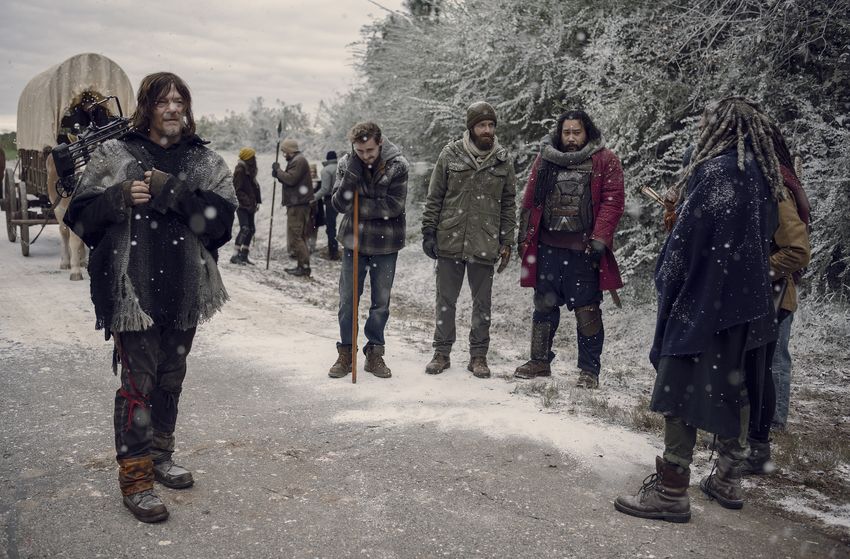
For the first time ever in The Walking Dead, snow makes an onscreen appearance, serving not only as a unique visual setting, but as a defining characteristic of this episode. In what ends up being the fourth and final time jump of the season, ‘The Storm’ takes place just a few months after the events of the previous episode, with the sudden snowfall providing a subtle, yet creative way to demonstrate the passage of time. In the early days of the comics, snow had a huge impact on the characters and their choices, and in the context of pure survival, it does offer up a unique set of challenges in this episode, even without factoring in the typical dangers of the zombie apocalypse. Poor visibility, dwindling supplies, and of course, freezing temperatures, all throw our heroes for a loop, and getting to see our favorite apocalypse-hardened characters tested in new ways is just another example of The Walking Dead’s season nine renaissance. It’s been a long time since surviving the elements was a legitimate concern in the show, and it’s fun to see the series get back to these familiar roots through such distinctive means.

The frigid Virginian winter isn’t the only thing the group must contend with, though. When forced to take shelter in the dilapidated husk of The Sanctuary, the community leaders realize that the conditions are worsening too rapidly, and that travel along their original route to The Hilltop is all but impossible. Without enough supplies to stand pat and wait out the storm, the group is forced into a decision – either do nothing and perish or try to beat out the storm by taking a shortcut straight through Whisperer territory. The choices are clear, and the situation itself simple. This isn’t some garish three-pronged assault on a Savior satellite outpost, or a bloodied Rick Grimes blearily leading a herd of walkers over the promise of a collapsing bridge. This is a real dilemma, with real debate, and real stakes, proving that last week’s pikes scene wasn’t just a means to provide cheap shock value (a route The Walking Dead has most assuredly taken in the past). No, there are actual repercussions to the events of last week’s episode that go beyond people feeling sad or scared, and getting to see this storyline flow and enact consequence so naturally is one of the most rewarding things the show has ever done.
(Photo Credit: AMC)
Season nine has been, by far, The Walking Dead’s best effort at consistently exploring storylines to their full extent. In the season finale, we get to see several main characters come full circle with their character development from the start of the season, which is impressive when you consider how much in-show time has passed between these two points (hint: it’s over six years). For instance, we get Daryl making his return to The Sanctuary, a place that he hated so much that he spurned all of his responsibilities as its leader to ultimately spend the entire time jump living on his own in the woods. But, after the events of 9B, Daryl is not only back in The Sanctuary, but he’s also reunited with his friends, taking a leadership role in leading The Kingdom to The Hilltop, and for the first time in a long time, he decides to settle down on a more permanent basis, putting down roots in the community where it all started, Alexandria.

Michonne also sees her season arc come full circle, when she comes to terms with the error in judgment she made by isolating Alexandria from the rest of the communities. In a conversation with Ezekiel, Michonne implies that she takes most of the blame for what happened at the trade fair, realizing that Alpha would have never been able to infiltrate The Kingdom so easily, if the communities had kept tighter bonds over the years. Post-time jump Michonne is initially almost unrecognizable compared to the community charter advocate we saw at the beginning of the season. It was a long and windy road, but by the end of season nine, we finally get to see Michonne embrace the ideals of unification that she once held so dear. With Danai Gurira set to leave The Walking Dead next season, how will this change of heart play into her future storylines?
(Photo Credit: AMC)
Unfortunately, it’s not all triumph for characters whose arcs come full circle. After living a post-time jump life that she describes as a “fairy tale,” Carol’s world comes crashing down around her in the aftermath of Henry’s death. Not only does Carol admit that she feels herself slipping back into her old ways, similar to the path she first walked when Sophia died back in season two, but she also ends her marriage to Ezekiel, as season nine opened with their proposal, and ends with Carol’s attempt to return the ring to her former King. The parallels between Carol and Ezekiel’s relationship and The Kingdom are interesting. The Kingdom, arguably the strongest of the communities, when we’re first introduced to them in season seven, falls first. While, Carol and Ezekiel, two of the show’s strongest characters simultaneously see their relationship deteriorate – a sadly all too common fate for parents who lose a child.

And with that, The Walking Dead comes to a close on what’s been its best season, yet. It’s hard to believe that a show that’s been on the wrong side of so many jokes in recent years has managed to not only return, but to transcend its former glory in just one season. Give credit to showrunner Angela Kang and her team of writers for focusing their efforts on what makes The Walking Dead great and stripping away all the rest. The realist in me feels the need to spread words of caution – that it’s only been one season, and even a broken clock is right twice a day. But I truly think this show has turned a corner, and stringing together sixteen good to amazing episodes is no small feat. Just like our scrappy group of survivors, The Walking Dead proved it could survive, and ultimately thrive if given the support of the right people.
(Photo Credit: AMC)

Wednesday, March 27, 2019

The Walking Dead Season 9, Episode 15 Review: 'The Calm Before'

(Photo Credit: AMC)
The Walking Dead
Season 9, Episode 15
By Garrett Yoshitomi

Warning: This review contains major spoilers for season nine, episode fifteen, and beyond.

Now that’s what I call a finale! With The Walking Dead enjoying something of a renaissance under its new showrunner, Angela Kang sends her inaugural season out with a bang with a well-crafted season finale that…Wait. You mean that wasn’t the season finale? There’s still one episode left to go? Chortle all you want, but if it weren’t for the number fifteen before the title, this week’s episode, ‘The Calm Before,’ would appear to have all the makings of a season finale and then some, with a story that unites several season-long plot lines, all while escalating towards a chilling, heart wrenching climax. The fact that ‘The Calm Before’ is actually the penultimate episode of the season represents a nice change of pace to the typical season structure for The Walking Dead, which often ends with a sharp cliffhanger. Instead, we get one last episode to see the aftermath of what’s undoubtedly one of the show’s biggest moments, and given the magnitude of the events that transpire, one episode might not be enough to unpack all of the repercussions that are sure to follow.

For the most part, this episode is very pleasant, with a lot of attention placed on the community trade fair and its success in reuniting former allies, Alexandria, The Hilltop, The Kingdom, and even Oceanside, who make their first appearance since the time-jump. After several episodes of buildup, it’s fun to see the fair finally come together, and as King Ezekiel mentions in his opening speech, it really does feel like the unified world that Rick Grimes always dreamed of. We get a heartwarming scene between the various community leaders as they decide to get the band back together, and officially sign the charter that Michonne crafted all those years ago. In addition, the communities agree to a mutual protection pact, meaning that an attack on one community is an attack against all communities – an arrangement that conveniently feels like it’s going to be coming into play very soon.
(Photo Credit: AMC)
But it’s not all dunk tanks and caramel apples for our beloved survivors. This overall feeling of frivolity might feel innocuous; but in reality, it’s meant to lull viewers into a false sense of security, with several minor character interactions innocently woven throughout the episode, in the hopes that they’ll misdirect even the most eagle-eyed of fans from discerning the final outcome of The Whisperers’ plot. This episode actually starts off with a short flashback scene with a foreboding ending that establishes an overarching sense of dread that lingers throughout the festivities, unsettling viewers as they wait for the other shoe to drop. This sense of dread eventually comes to a head, and when the big reveal takes center stage, the swell of the musical score, the sweeping cinematography, and of course, the performances of some of the show’s most beloved actors, deliver an ending that will go down as arguably the most moving and well-realized sequence in Walking Dead history.

As great as this episode is, though, the lack of a truly major character death does make the ending feel like something of a cop-out. In the comics (pushes glasses up nose), not only do The Whisperers claim more victims compared to the show, but the characters who die differ greatly, as well. The two most prominent comic casualties, who manage to survive in the show, are King Ezekiel and Rosita Espinosa. Of course, it’s not uncommon for the show and comic to diverge when it comes to killing off its characters. In fact, most characters in the show will end up suffering much different fates than their comic book counterparts. The one exception to this are the key deaths in the series that are significant in a way that transcend typical levels of character and plot development – these are the milestone deaths that represent huge turning points in the narrative, like Shane in season two and Glenn in season six. 
(Photo Credit: AMC)
“The pikes” should have been one of these moments – it is in the comics, at least. But, the lack of a truly impactful death unfortunately prevents this from happening and keeps ‘The Calm Before’ from reaching its full creative potential. Of the major deaths, neither Enid, Tara, nor Henry particularly scream “significant,” and while I can appreciate the feeling of unprejudiced randomness that Alpha implemented when choosing her victims, the big reveal at the end of the episode could have been so much better with a true gut punch of a character death. I’m not necessarily saying that a major character has to die in order for an episode to be good; but stakes matter, and if The Walking Dead really wants to capture an “anyone can go at any time” feeling, it has to sacrifice the occasional marlin, rather than just guppies.

To be fair, “just guppies” is a bit…harsh. After all, outside of the core 3 of Daryl, Carol, and Michonne, Tara is the most veteran character on the show (surprising I know), so from a seniority perspective, her death should carry significant weight. After several years of very little character development, it felt like Tara was finally coming into her own once she assumed leadership duties over The Hilltop. It’s a shame that Tara’s time on the show comes to a close just when her arc finally starts to pick up. The same could be said for Enid, who was introduced back in season five, but really hasn’t been given that much focus up until recently. This season, Enid was paired with former Savior-turned-good guy, Alden, and while it’s not the most complex storyline, the two made for a likeable couple and I enjoyed seeing Enid’s transformation from the introverted teen we first met at Alexandria, to the caring and confident young woman we see at The Hilltop, post-time jump.
(Photo Credit: AMC)
So that leaves us with Henry. Despite being generally unpopular with fans, and rather frustrating to watch throughout the season, Henry’s death is setup to be the big loss of the episode, and believe it or not, I actually think he’s the one character who’s actually able to pull this off. Say what you want about the adopted son of Carol and Ezekiel, but his storyline with Lydia has been the heart of 9B, and after getting off to a rocky start to his post-time jump storyline, he’s been a pretty solid character to root for – relatable in his mildly awkward, but genuine, displays of affection for Lydia, and so unafraid to stand up for what’s right that it almost makes up for the fact that this entire conflict with The Whisperers is basically his fault. Almost. Looking back, it makes sense why Henry was featured so prominently this season. At first, it seemed like he would be getting a portion of Carl’s storylines from the comics, but it’s easy to see now that we were meant to grow invested in Henry as a character, as well as the relationships he maintained and developed throughout the season.

One of those relationships, which will by far be the most interesting one to watch going forward, is with Carol. Carol’s already suffered through so much during her time on the show that it’s unfortunately not very surprising to see her lose Henry as soon as things appeared to be trending upward. Carol hasn’t had a ton to do this season outside of some peripheral work with the trade fair, but it’s likely that in the aftermath of the pikes, she’ll be brought back into the fold. Carol is one of the OGs, and at the rate they’re departing from the series, OGs are a valuable commodity for The Walking Dead, and any amount of increased screentime is more than welcome for Carol. While I still believe that it would have been more compelling to watch her cope with an Ezekiel death (we’ve already seen versions of Carol come to terms with children she cares about dying), Henry is the next closest character to her, and I think Carol and Ezekiel both learning to cope with the loss of their son is an interesting dynamic worth exploring.
(Photo Credit: AMC)
Ultimately, I think the writers made the best decision they could have when it came to which characters to kill off. With the recent departures of Rick and Maggie, and reports of Michonne leaving as soon as next season, the show probably couldn’t really afford to lose any more major characters in such a short amount of time. Plus, even if we didn’t get a huge death, the fact that ten supporting characters were offed all in one go is still super significant for the show. This does lead me to wonder, though, if The Walking Deadhas failed to craft enough impactful characters to allow them the flexibility to write off popular characters when it suits the wider narrative. Ask yourself this – are there any characters who have been introduced post-season three that would carry this kind of impact if killed off? Ezekiel feels like the most obvious answer, but even then, the King’s only been around since season seven. Eugene, Rosita, Gabriel, and Aaron are the next longest tenured series regulars after the core 3, and their narrative scopes are too narrow to really destabilize the show in any meaningful way if they were to exit the series.

I’ve written at length about how much The Walking Deadhas improved this season under new showrunner Angela Kang. And, I was also quick to point out that Rick’s departure earlier this season could actually be beneficial to the show, by opening up screentime that could go to other characters. Focusing too closely on just a handful of characters is a problem that’s plagued The Walking Dead for almost its entire run. But it is possible that the show could be repeating this same mistake, only instead of focusing too much on Rick, it’s Daryl receiving more than his fair share of screentime, minimizing the opportunities for other characters to step into the spotlight. Granted, no matter how creative a show gets, there will always be characters who receive more focus than others – not everyone gets to play quarterback. But overall, it would be beneficial for the show to give crucial roles to a wider range of characters, even if it means we have to say, “good bye” to them sooner, rather than later.
(Photo Credit: AMC)
It’s hard to imagine following up an episode like this one, but if there’s any show that can do it, it’s Angela Kang’s new look Walking Dead. Based on the previews that have been released, it looks like we’ll be getting another time-jump; albeit this one will be much shorter than the six year one we got in 9A. Still, I love the narrative use of time-jumps this season, and I think it fits perfectly with the storytelling of The Walking Dead. This is a show all about surviving the zombie apocalypse, and the deep running consequences that matter during the end of the world can sometimes only be glimpsed when enough time has passed. Another short time-jump bypasses the immediate emotional fallout from ‘The Calm Before,’ and instead allows the season finale to focus on the more practical concerns that have developed in the passing months.

Tuesday, March 19, 2019

The Walking Dead Season 9, Episode 14 Review: ‘Scars’

(Photo Credit: AMC)
The Walking Dead
Season 9, Episode 14
By Garrett Yoshitomi

After months of speculation, we finally learn the story behind Michonne and Daryl’s mysterious ‘X’ scars, as well as the true reason behind the strict ‘no fly’ rules imposed on Alexandria during the time-jump. Season nine, episode fourteen, ‘Scars,’ shifts between two timelines, exploring the past events that caused Alexandria to close its walls to the outside world, and the consequences these events have on the present storyline. Because this episode takes place outside of the trade fair-Whisperers storyline, it’s fair to label it as filler. But, as we’ve seen this season, filler episodes under the Angela Kang-era haven’t been the outright throwaway storylines that we’ve seen in years past. Instead, ‘Scars’ is an absolute thrill of an episode, leading some to call it the show’s best ever. I’m not sure if I’m willing to go that far, but I honestly can’t say those claims are wrong, as ‘Scars’ is insanely good, and sucks the oxygen out of the room in a way that very, very few Walking Dead episodes ever have.
(Photo Credit: AMC)
You can evaluate ‘Scars’ in two ways: as a standalone episode and as another piece to the wider narrative puzzle. As a standalone episode, ‘Scars’ actually starts off noticeably slow, but this is intentional to better play into the twist that takes hold halfway through the hour. The twist itself isn’t entirely unexpected, but the lengths to which it goes are, and I think this dynamic is what makes the episode itself so compelling. Over the years, we’ve seen a lot of gruesome fates befall characters both good and bad; but for me at least, this is the first time The Walking Dead has ever shown me something that was actually unsettling. I can understand how this could be experienced as a turnoff for some viewers, and I’ll admit that I did spend a minute or two during a commercial break trying to unpack my thoughts about what I had just watched. But, regardless of your feelings towards this episode’s climax, I think the fact that an episode of The Walking Deadis able to elicit such a strong emotional response is a good thing and speaks to the high-quality writing that Angela Kang and her staff have helped bring to the show.

When looking at this episode in the context of the rest of the season, though, things get a bit more complicated. Throughout the whole season, we’ve been teased with hints of something truly horrible happening to Michonne and Daryl during the time jump; and now that it’s finally time to collect on that promise, a few plot points stand out that leave me scratching my head at what’s otherwise a stellar episode. For starters, it’s hard to feel fully invested in the betrayal that Michonne suffers, when the traitor in question is introduced in the very same episode as their double-cross. There isn’t a ton of context provided for their relationship with Michonne either, and while it doesn’t diminish the horrifying nature of what Michonne suffers, it does feed some doubt as to whether the betrayal of a friend from over a decade ago, is enough to completely erode the relationships that Michonne has now.
(Photo Credit: AMC)
So often in The Walking Dead,we’ve seen our heroes struggle to hold onto their faith and humanity, only to ultimately find strength in their allies. Time and time again, the wider benefits of unity and companionship have far outweighed the more practical “survive at all costs” mentality that our group spent season after season dispelling. Michonne exhibited these beliefs quite possibly more than any other character, and it does seem uncharacteristic for her to forego her friends in her greatest time of need. Sure, we’re supposed to be convinced that what happens in this episode is so terrible that it drives even Michonne to turn her back on The Kingdom and The Hilltop. But just because something is objectively terrible, doesn’t mean that it automatically gets to overrule characterizations that have run deep for several years. This episode gives us a satisfying answer to why Michonne, and by extension, Alexandria has closed itself off to the world - I’m just not entirely convinced that it’s the best version of that answer that we could have gotten.

One thing that holds true for this episode, whether you’re looking at it in isolation or within the larger season, are the performances from its two leading women, Danai Gurira (Michonne) and Cailey Fleming (Judith). After spending most of the season on the periphery, Michonne is front and center this week, in a storyline that goes beyond typical Michonne badassery. It’s not often in film and television that you get to see a pregnant woman display the kind of agency that Michonne has in this episode. Nobody has to come to her rescue, and nobody has to fight for her, as Michonne proves that baby or no baby, she’s more than capable of holding her own against even the most unlikely of foes. Gurira’s performance throughout the last act of this episode is extremely powerful, some of the best stuff we’ve seen on The Walking Dead. You can feel her desperation as she staggers through the building she’s trapped in, and every swing of her katana feels like a memory that’s etched forever not just in Michonne’s memory, but in ours, as well. And, when Michonne finally reunites with Judith, a taste of bittersweetness fills us, as we know just what it took to bring these two back together.
(Photo Credit: AMC)
Fortunately, the present-day scene of Michonne finding Judith is much more of a heartwarmer, and Cailey Fleming once again proves that she can hang with the big girls, establishing herself as a major player in this show thanks to her precocious portrayal of the sweet, yet capable, Judith Grimes. Fleming’s portrayal of Judith has been a low key super important part of season nine’s success. It might feel like the show’s latest leading Grimes was always going to be a slam dunk fan favorite, but The Walking Deadhas had an uneven track record with creating likeable child characters, and coming into the second half of season nine, there was some uncertainty with where exactly Judith would fit. So far, she’s been used sparingly, which is smart – small doses are a good thing, and as progressive as The Walking Deadcan be, a nine-year-old child is still a character who you probablyshouldn’t try and fit into every subplot. The parts that Judith is in, though, are perfectly tailored to showcase her grit and autonomy, and she displays great rapport with strong personalities like Negan and Michonne.

We’re only two weeks away from the season finale, and surprisingly enough, it feels like there’s still a lot to cram into these final two hours. At this point in a typical Walking Dead season, the pace starts to slow to a crawl, as the inevitable conclusion to the season is just within grasp, but the remaining story needs to be stretched out to meet the required number of episodes. Given how strong this season has been, I’m expecting Angela Kang to send her inaugural season out with a bang. Comic readers will surely know what’s in store next, but the writers have done a skillful enough job at hiding their hand that even diehard fans can’t be 100% sure how things will unfold – yet another reason why season nine of The Walking Deadcould be the show’s best.

Monday, March 18, 2019

The Walking Dead Season 9, Episode 13 Review: 'Chokepoint'

(Photo Credit: AMC)
The Walking Dead
Season 9, Episode 13
By Garrett Yoshitomi

You expect trailers for movies and TV shows to tease, entice, and generally enhance audience interest for new releases and future episodes. Trailers, at least for me, are interesting because while they can be immensely popular – trailers for properties like The Avengers and Game of Thrones routinely get tens of millions of views – they actually divulge very little information and can sometimes be outright misleading. So, what is it about trailers that captures the attentions of so many anxiously awaiting fans? It’s the payoff. The moment when that awesome scene you snuck a peek at in a trailer makes its way into the main event, not only makes the trailer retroactively better, but raises our level of excitement at the prospect of future trailers delivering on the same promise. The midseason trailer for season nine of The Walking Dead was no exception to this. As soon as the trailer hinted at Beta and Daryl’s epic, knife twirling clash, their inevitable fight has been gaining Clegane Bowl levels of hype within The Walking Dead fandom. The thirteenth episode of season nine, ‘Chokepoint,’ delivers on this hype in a major way, and the fight between Daryl and Beta could very well go down as the best in Walking Dead history.
(Photo Credit: AMC)
Last episode was the first time we saw Beta onscreen, but this week represents his true coming out party, as we finally get to see what Alpha’s main lieutenant is fully capable of. A man of seemingly few words, Beta is a hulking figure, one of the largest the show has seen. And, although the only physicality he’d shown up until this point was shoving Henry around, his sheer size alone lends us to believe that he should be more than a match for fan favorite, Daryl. Suffice it to say, this fight is epic, and Beta definitely lives up to his billing as The Whisperers’ most lethal member. The way he immediately starts ragdolling the highly capable Daryl sets the stakes high for this encounter, but Daryl manages to get his licks in, too, in a way that feels believable and true to the latter’s clever and skilled fighting style.

The back and forth action in this scene is great, and almost creates its own mini narrative for the two minutes these characters spend grappling. And, even though the overall outcome of the fight seems somewhat assured, watching it climb to that conclusion is quite simply, a thrill. Unfortunately, the same can’t be said for some of The Walking Dead’s other previously hyped up brawls. For instance, Rick’s encounter with the Governor in the season four midseason finale started off with a bang, but quickly devolved into a predictable straddle-punch-fest. More recently, Rick and Negan’s slap fight in the season eight finale lacked all the excitement of its comic book counterpart, resulting in a highly underwhelming conclusion to the show’s disappointing adaptation of the All-Out War arc. However, if the Daryl-Beta confrontation is any kind of indication, our days of lackluster Walking Dead fights could be coming to a close, which is perfect timing as the season zooms forward with the rest of The Whisperers storyline.
(Photo Credit: AMC)
The Whisperers storyline is interesting because while primary antagonists Alpha and Beta grab all the headlines, the storyline itself is actually driven by Lydia. Even though Lydia has shifted into the background in recent episodes, it’s her absence that’s forced The Whisperers into pursuing Daryl, Connie, and Henry, in order to rescue her. Lydia also straddles the line between both camps in a subtle, genuine way. This isn’t the classic “can’t trust the outsider” trope that The Walking Dead has often played with before. It truly seems like Lydia is fighting back a real sense of loyalty to The Whisperers, to allow her to explore new and equally real feelings for Henry. For now, it does seem like Lydia’s cast her lot in with Team Family, but does that commitment start and end with Henry, or does it extend to the rest of The Hilltop, The Kingdom, and Alexandria? One thing’s for sure, this episode won’t be the last time we see Lydia’s allegiances tested.

The Hilltop’s not the only one making new friends, though. This week, The Kingdom encounters a group of “Highwaymen,” who initially threaten the safety of the roads leading to The Kingdom’s upcoming trade fair. The Highwaymen are a new group, unique to the show, and believed to have stepped into the power vacuum created when Carol dispatched of Jed’s rogue group of Saviors back in the midseason premiere. It’s cool to see this little ripple effect take hold, and this minor plot point actually goes a long way in lending a sense of realism to this fictional, apocalyptic world. The show so often focuses on just a few key groups, that it creates this feeling of a bubble between this one small corner of Virginia and the rest of the world. But there are other survivors out there, and it makes sense that they’d be vying for not only resources, but territory, as well.
(Photo Credit: AMC)
So, when The Kingdom rallies its forces to fight back against this new, looming threat, a sense of déjà vu starts to set in for viewers who are all too familiar with what happens when a gang of ne’er-do-well’s cross paths with Queen Carol. And yet, what could have easily been another ho-hum side adventure turns into a rather pleasant surprise, as The Highwaymen subplot takes an unexpected turn, avoiding the type of murder-y conflict and exasperated pleas that everyone can “walk away from all this,” that The Walking Dead typically succumbs to, instead delivering an enjoyably light snack amid the weighty entrée that is The Whisperers arc – an outcome that is as unique as the group of would be bandits who perpetrate it.

Thursday, March 7, 2019

The Walking Dead Season 9, Episode 12 Review: 'Guadians'

(Photo Credit: AMC)
The Walking Dead
Season 9, Episode 12
By Garrett Yoshitomi

We’re halfway to the season nine finale, and this week’s episode of The Walking Dead, ‘Guardians,’ builds on two major storylines that should grow into the dominate narratives that shape the remainder of the season. The Whisperers conflict and the upcoming community trade fair may seem like separate subplots as of now, but they’ll likely converge by season’s end, and this episode does a good job of laying the foundation, by providing solid world-building for both The Whisperers and their nomadic lifestyle, as well as Alexandria and Michonne’s decision to forego the fair.

If you’re a fan of townhall debates, you probably enjoyed watching Alexandria’s council argue the merits of attending the upcoming trade fair. However, if the lifeblood of democracy isn’t really your thing, you can still find value in the precious world-building that this scene provides, as it lays out the dynamic for the council, and how their way of thinking has evolved over the six-year time-jump. With the exception of the prison back in season four, and the early days of Alexandria with Deanna, there haven’t been a ton of opportunities to watch organized democracy in The Walking Dead’s history. For the most part, our characters have been governed by the iron fist of the Ricktatorship. But, with Sheriff Grimes off to greener pastures, for the first time ever, it’s up to the remaining characters to establish some sense of governance.

It’s still unclear what led to the creation of the council, but we do learn that Gabriel serves as its leader, and is joined by Michonne, Aaron, Siddiq, and former Savior, Laura, as members. Supposedly, at its impetus, the council voted and made rulings together, but over time, that democratic approach shifted once Michonne, as head of security, was granted final veto power over all of the council’s decisions. Predictably, and as Gabriel points out, unfairly, this results in a system where Michonne gets to decide what happens, regardless of how the rest of the council votes. However, both Michonne, as well as Aaron, argue that this rule was put in place for a reason, and although it seems like an absurd amount of power to bestow in one person, there was clearly a time where the council believed it was the right call.
(Photo Credit: AMC)
But what exactly led the council to make this call in the first place, and when will we learn why Alexandria closed itself off to its allies in the outside world? The show hinted back in episode six, the first post-time jump episode, that something seriously sketchy went down in Alexandria sometime during the six years since Rick’s “death.” We get another hint in episode seven, when Daryl reveals an “X”-shaped scar on his back in the same location as Michonne’s from the previous episode. We’re now on episode twelve. And, while six episodes isn’t too long of a stretch to keep the curtains closed on what’s ramping up to being one of the series’ biggest mysteries, it is a long time to go without any new information, and the second half of season nine has been noticeably mum when it comes to this elusive subplot.

On the whole, this lack of progress isn’t hugely detrimental to the show because it’s been able to rely on the Whisperers arc to carry most of the season. It is unfortunate, though, that this stalled storyline has turned fan favorite Michonne into a rather unenjoyable character – almost unrecognizable in her outward detachment towards the friends she used to hold so dear. It wasn’t that long ago when Michonne was the most vocal for creating a charter that would unite the allied communities under one set of world rebuilding rules. And, in general, Michonne has always been a character who believes in the power of building relationships, as opposed to Rick, who often had difficulty in trusting those outside of his core group. If the mystery of the “X”-shaped scar storyline doesn’t deliver on its promise of providing a horrifying and justified reason for Michonne’s fear-driven isolation, her entire post-Rick arc will seem like a complete waste of what should be one of The Walking Dead’s most easily bankable characters.
(Photo Credit: AMC)
If there’s one redeeming aspect to Michonne’s storyline, it’s the interesting parallel you can draw between the isolationist tendencies of both Alexandria and The Whisperers. While it’s obvious that Alexandria is nowhere near as far gone as The Whisperers, what with the latter’s walker skin drying racks and trial by combat electoral system, their closed borders approach does set a dangerous precedent when it comes to the group’s long-term prosperity. If your only goal is to survive, then sure, limiting the number of people you interact with will help that cause – nobody can kill you if you never cross paths with them in the first place. But there are downsides when a community puts such a premium on its own survival that it goes to the unsustainable lengths of completely closing itself off from other people.

We’ve seen it before in past seasons. A place like Terminus initially welcomed visitors in with open arms, but quickly learned to mistrust strangers after letting the wrong group of people past their gates. Eventually, the residents of Terminus turned all kinds of weird when they literally resorted to eating people they came into contact with. Another season five location, Grady Memorial Hospital, started out as a community of police officers, hospital staff, and patients, who were able to wait out the early days of the apocalypse thanks to the hospital’s massive structural size and sturdy walls. However, these same walls that kept the walkers out, also kept its inhabitants in, allowing frightening and brutal power dynamics to develop between the officers and the rest of the inhabitants. And, let’s not forget about Morgan, who probably serves as The Walking Dead’s greatest example of all that can go wrong with a person whenthey’re deprived of too much human interaction. After losing his wife and son towards the beginning of the outbreak, Morgan became a shell of himself-losing his mind, turning volatile and violent, and almost killing his friend, Rick, in the midst of his mania.
(Photo Credit: AMC)
And now we have The Whisperers who, unlike the groups mentioned above, appear to be thriving in their isolation – surviving the harshest of elements, deep into the zombie apocalypse, thanks to their animalistic lifestyle.But, how long can this last? Alpha herself admits in this episode that it’s been years since her leadership was challenged, and that this instance “felt different" compared to past uprisings. The fact that cracks have started to form even within The Whisperers should be all the proof Alexandria needs to start rebuilding bridges, either literally or metaphorically, with The Hilltop and Kingdom. By episode’s end, it appears that this is the direction they’re leaning, and we should see soon, in the coming weeks, whether it’s the right choice.

Thursday, February 28, 2019

The Walking Dead Season 9, Episode 11 Review: 'Bounty'

(Photo Credit: AMC)
The Walking Dead
Season 9, Episode 11
By Garrett Yoshitomi

After several weeks of dipping its toes in the water, The Walking Deadfinally takes the plunge into The Whisperers storyline, as ‘Bounty’ gives us the first face-to-face confrontation between our heroes and Alpha. And, while Alpha and her band of masked followers live up to their billing as one of the show’s creepiest foes, their storyline as a whole loses some of its bite, when juxtaposed with the more upbeat Kingdom side plot that’s featured in this episode. This subplot, in which Ezekiel leads a group from the Kingdom in search of a movie projector bulb, is a perfectly enjoyable story on its own, but ultimately feels out of place when scenes of Jerry singing along to funk music are spliced with the considerably tenser stand-off between Daryl and Alpha.

It can be hard for antagonists to maintain a consistent air of danger and menace, especially for The Walking Dead, which took a perfectly lethal and terrifying Negan, and gradually reduced him to nothing more than a smirking quip with a baseball bat. So far, in the early going of season 9B, The Whisperers are just as frightening as they were during their initial introduction in the midseason finale. Unlike the midseason finale; however, there’s no fog-filled cemetery for these new foes to conceal themselves – they're out in the open and standing at the gates of The Hilltop. Without the element of surprise, it does feel like The Whisperers could be disposed of quite quickly by our heroes. Daryl says as much when he threatens Alpha with “enough firepower to light you up.” 
(Photo Credit: AMC)
But what The Whisperers may lack in resources, they more than make up for with a frightening feral nature that unsettles even the battle-tested and better armed Hilltop. Any doubts about The Whisperers’ commitment to their animalistic lifestyle are immediately put to rest when one of The Whisperers leaves her baby to be devoured by walkers, rather than let its cries attract more of a herd. A cold-blooded move in the eyes of many, but to Alpha just natural selection. This unfeeling, utilitarian mindset is something we haven’t seen since The Governor. But, unlike The Governor, who’s contrived story arc saw him completely lose his freaking mind less than a year into the apocalypse, The Whisperershave had almost a decade of the end of the world to mold their psychosis into the controlled madness we see today.

If there’s one thing that caninhibit The Whisperers’ threateningness, it’s this episode’s insistence on juxtaposing the seriousness of their storyline with the lightheartedness of The Kingdom’s quest for a movie night. The Walking Dead has a shaky track record of attempting to inject levity into its typically dark subject matter. Sure, the past few seasons have given us memorable lighter moments like Carl snacking on pudding, Rick and Michonne falling through a roof onto a pile of mattresses, and Tara flipping the bird to the entire Oceanside community. But these scenes, while fun in the moment, are just minor detours from the gloom and foreboding that dominate the rest of the episodes they’re a part of.
(Photo Credit: AMC)
Simply put, it’s rare for there to be an episode of The Walking Deadthat’s just plain…fun. Rick and Daryl’s buddy road trip episode, ‘The Next World,’ probably comes the closest. And, while it’s unrealistic to except every episode of this show to focus on good time happy sunshine feelings, I feel like it’s an important dynamic to explore that helps us feel more invested in characters by making them seem more relatable, and ultimately creates a stronger sense of dramatic stakes when these characters inevitably come into peril. This week’s movie projector storyline could have accomplished this well, if it had been given the proper attention.

The Kingdom’s inherent whimsical nature and larger than life characters, like Ezekiel and Jerry, fit in well with the lighthearted nature of their quest for a movie projector bulb. Unfortunately, this is a bit hard to appreciate when the episode keeps shifting to the tonally heavier Hilltop storyline. You could argue that this kind of frivolous subplot wouldn’t be able to carry an episode by itself; and thus, needs a more narratively serious A-plot to balance it out. However, this juxtaposed tone that The Walking Deadhas a history of leaning on, ultimately just ends up detracting from both plots- the more fun storyline is dragged down, while the more serious storyline loses some of its dramatic tension.
(Photo Credit: AMC)
And, although searching for what’s basically a light bulb may seem less exciting than current events at The Hilltop, an entire episode focused on The Kingdom would have served as a welcome check-in with a significant portion of the cast who are currently on the sidelines of the primary Whisperers arc. Major characters like Carol and Ezekiel have mostly been relegated to the background so far in this post-time jump world, in favor of subplots that take the story through Alexandria and The Hilltop, instead. But, The Kingdom is still a key player in this series, and as hosts to the upcoming community fair, it's likely that their role in the narrative will soon expand. We’re almost to the halfway point of season 9B, and with a couple of build-up episodes taking place recently, you can expect there to be an uptick in action over the coming weeks, before another cooldown leading into a ramp-up to the season finale.

Tuesday, February 19, 2019

The Walking Dead Season 9, Episode 10 Review: 'Omega'

(Photo Credit: AMC)
The Walking Dead 
Season 9, Episode 10
By Garrett Yoshitomi

For the second straight week, The Walking Dead delivers an episode that’s focused more on character development and story building, rather than action and zombie guts. And, for the second straight week, this approach pays off, as ‘Omega,’ serves as a well-paced, entertaining episode that establishes a proper background for newcomer Lydia, while also subtly exploring the origin story of her mom, Alpha. This type of “slow burn” approach isn’t entirely new to The Walking Dead – stretches of bland filler episodes, with only the occasional worthwhile character moment, have plagued this series for almost its entire existence. However, what is new, at least for this season, is the quality of said “filler” episodes, and the way they’re able to properly enhance the wider narrative with well-written character-centered subplots. 

So, what exactly constitutes a “filler” episode? Primarily, filler episodes feature one or two character-driven storylines that focus on character development rather than major plot progression. Of course, filler episodes still have plots, but the way they relate these plots to the overall season is much less about moving from point A to point B along a story arc, and more about moving characters from point A to point B on their own personal trajectories. “Filler episode” has a bit of a negative connotation, but I think that’s only because they tend to feel “boring,” especially when compared to episodes that more overtly move the plot forward. Filler episodes can also seem disruptive, killing a season’s momentum by shifting away from the more exciting, usually action-filled parts of the story, and instead, forcing the audience to reflect on the characters and their place in the narrative. 
(Photo Credit: AMC)
What’s great about this week’s dose of filler is that it not only functions well as a standalone episode; as the plot itself is entertaining enough on its own, but it also fits perfectly within the rest of the season, developing characters in a way that augments their presence and our investment in their roles for the major events to come. Sadly, most filler episodes in The Walking Dead fail to do both these things, which makes the quality of this week’s episode all the more notable of an achievement. Ultimately, I think the key to any great filler episode is squeezing every last drop of juice out of its plotline’s narrow range, and ‘Omega’ does this beautifully by providing simultaneous character development for Daryl, Lydia, and even Alpha, all within the same subplot. 

This week’s episode takes place solely at The Hilltop and its surrounding areas, as the captured Whisperer storyline that began last Sunday, gets into full swing. Daryl’s plan to use Henry to coax information out of Lydia works initially, but he is forced to abandon it once Henry begins to divulge too much information of their own. Throughout the episode, Lydia’s responses to both Daryl and Henry’s line of questions are mixed between real-time dialogue and non-linear flashbacks that are broken up over several scenes. In a vacuum, the flashback storyline is interesting to see play out. The pre-apocalyptic collapse of society is a story we’re familiar with, but don’t often get to see in The Walking Dead. And, while I agree with the show’s decision to avoid consistently flashing back to those early days of the outbreak, it’s fun to see occasionally, and Lydia and Alpha’s story, in particular, provides a compelling, unfiltered look into their characters. 
(Photo Credit: AMC)
Not only does this flashback provide insight into Lydia’s past life, but the way in which it’s presented gives us context for who she is now, as well. Throughout Lydia’s recounting of her past, subtle clues are dropped that hint at a possible discrepancy between her version of events and the truth. Daryl sniffs out these lies right away, but it’s not until the end of the episode that the audience is completely clued into what actually happened. This use of Lydia as an unreliable narrator is not only a clever narrative device, but it also helps with her characterization. Lydia’s inability to accurately retell events goes from seeming malicious to sympathetic, as the reason for her lapse in memory reveals the true extent of the hardships she’s suffered through. 

The show has often asked how children, like Carl or Henry, who spent the majority of their childhoods living in the zombie apocalypse, would ultimately turn out. Thanks to this season’s time-jump, we get to fast forward through these formative years for an answer to this question. The first half of the season introduced us to the more positive outcome, with a well-adjusted Judith Grimes surrounded by a protective and caring community in Alexandria. Lydia represents the other side of this coin, as the cold realities of the apocalypse turned a sweet, innocent child into everything it represents – dangerous, unfeeling, and utilitarian. We’ve seen many a character lose their humanity at the hands of the apocalypse, but we’ve never seen someone gain it back. If this is where Lydia’s story arc takes her, it should be an interesting ride. 
(Photo Credit: AMC)
So far, I’m enjoying Lydia as a new character, and her storyline could end up being one of the best of the season. There’s a fine line between menacing and ridiculous when it comes to dark and creepy teenage characters; but for the most part, I think Lydia comes across as believable, and it’s this believability that allows her to essentially carry this episode as its main focal point. Not only does Lydia’s development in this episode benefit her own characterization, but because her story is so entwined with her mother, her entire flashback story also functions as a “sneak peek” of Alpha, and helps us become more invested in her as a villain, before she’s even introduced. Alpha and The Whisperers are such a radical group, based solely on the idea that their way of life is the next step in human evolution – it makes sense to explore their transformation within the context of who these characters used to be. This emphasis on character background extends beyond just our new antagonist, though, as Daryl Dixon’s past receives a considerable amount of attention this week, as well. 

As part of this season’s Make Daryl Great Again movement, Lydia’s storyline also serves in drawing out a considerable amount of character development from Daryl. Daryl’s abusive upbringing was a big part of his character in the early seasons of The Walking Dead, but was abandoned around season five when he was separated from Beth, and in general seemed to coincide with Daryl’s overall decline in consistent character development. It is good that the show didn’t make Daryl’s past the sole focus of his character for nine years, but replacing that content with nothing was probably a worse decision. I’m glad to see the return of any kind of personal backstory for Daryl, as long as it means he’s not being ignored, and the fact that it fits in so well with the Lydia storyline is an added bonus. The Walking Dead has been largely uneven with the amount of time spent on giving proper backstories to its characters. If this change with Daryl turns into a trend for the rest of the show, I could see uninteresting filler episodes with shallow character development becoming a thing of the past, and that can only benefit the show as a whole, going forward. 

LinkWithin

Related Posts Plugin for WordPress, Blogger...